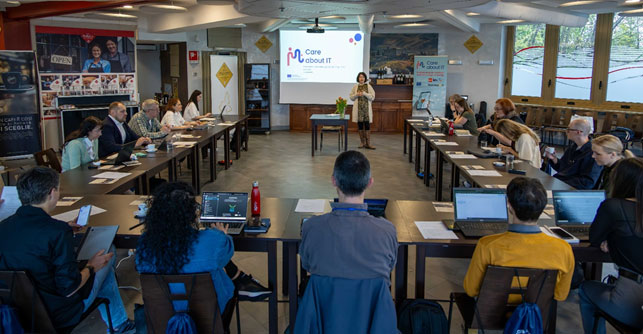
On Friday 3 July, the annual event organised by Apro Formazione as part of the European CoVE CARE about IT project – for which Apro is the Italian Country Captain in Italy – took place in the Novelab Theatre Hall in Novello.
The meeting brought together representatives from the local network, professionals from the health and social care sectors, experts and local stakeholders to discuss the challenges of digital health in the care of people with chronic conditions. Participants also included ASL CN2, the Professional Association of Nurses, Cooperativa Progetto Emmaus and Socialcoop, T4Med and Bi-Space.
The centrepiece of the event was a well-attended round-table discussion, designed as a forum for open discussion on experiences of using and integrating digital technologies into care pathways. The aim was to identify needs, challenges, necessary skills and best practices to make digital innovation increasingly accessible, effective and person-centred.
Digital healthcare from a local perspective: opportunities and challenges
Through the use of Mentimeter, participants were actively engaged in the discussion and were able to share their perceptions, experiences and priorities. The responses revealed a view of digital healthcare as a field full of potential, associated with terms such as telemedicine, innovation, accessibility, support and proximity, but also as a challenge that remains to be addressed. Digital technologies are already present in healthcare and care pathways, particularly through tools such as patient apps, devices for teleconsultations and telemonitoring, electronic health records and monitoring systems. This confirms that the topic is no longer distant or abstract, but is now part of the daily experience of professionals, services, patients and carers.
At the same time, the discussion highlighted certain essential conditions for digital innovation to be truly effective. Among the most common obstacles were resistance to change, bureaucracy, the difficulty of integrating new tools into work processes, the risk that technology might be perceived as an additional burden, and the need to provide better support for both healthcare professionals and the public. The factors that promote success, on the other hand, are linked to ease of use, perceived usefulness, the availability of support and guidance, training, and the tools’ ability to meet specific needs. From this perspective, the most relevant skills are not only digital, but also interpersonal, organisational and collaborative: communication with patients, change management, interdisciplinary work, trust and shared planning have emerged as key concepts for building a digital healthcare system that is truly accessible, sustainable and person-centred.
This finding highlights a key point: digital healthcare cannot be reduced to its technological dimension alone. To truly innovate services, interpersonal, organisational and collaborative skills are needed – skills capable of bringing together professionals, patients, carers, technicians and decision-makers.
The insights gathered fully confirm the direction of the CARE about IT project: to enhance skills in the fields of social and healthcare and IT, to promote innovative educational programmes, to foster exchange between students, professionals and international experts, and to contribute to mapping the needs of the digital healthcare ecosystem.
The event in Novello therefore represented not only an opportunity for discussion, but also a valuable chance to listen to the local community. The experiences shared by participants offer concrete guidance for developing training programmes that are increasingly tailored to the real needs of professionals, and for supporting digital innovation in care services in a sustainable, inclusive and person-centred way.
Our thanks go to all participants and the organisations involved for their active contribution to the discussion and for their commitment to working together to build new perspectives for digital healthcare.
For further information: Irene Miretti, Project Manager -